
Constructivist Lesson Plan: Steps and Examples
Most teachers have sat through a professional development session on constructivism and walked away with one unanswered question: what does this actually look like on paper? The theory makes sense. But translating Jean Piaget and Lev Vygotsky into a lesson plan you can deliver on Tuesday morning is a different challenge entirely.
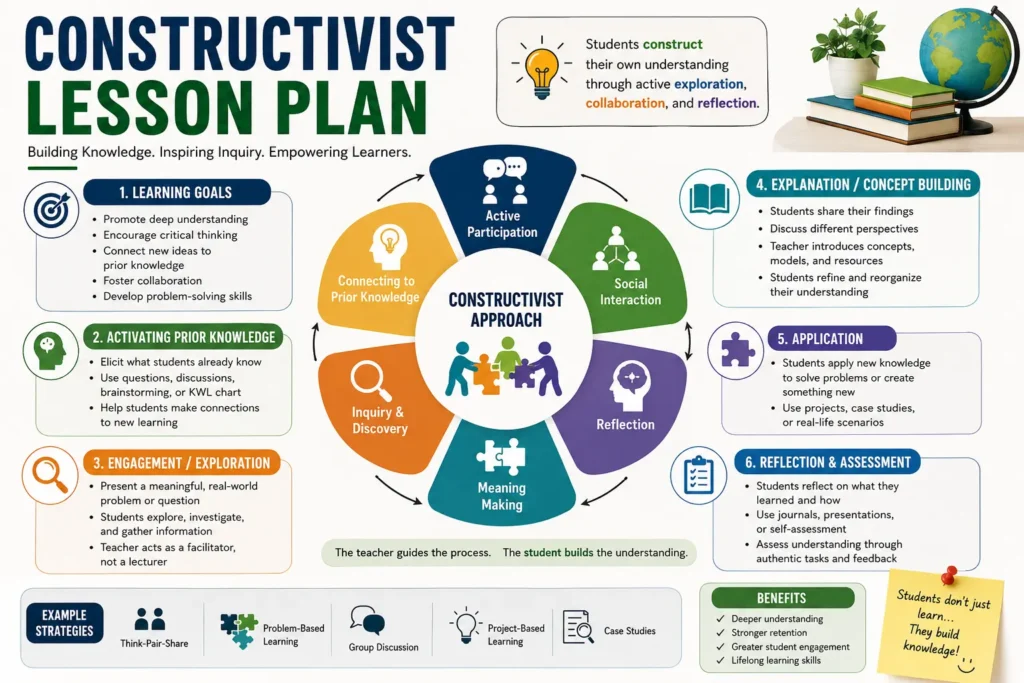
A constructivist lesson plan is a structured teaching document built around the idea that students learn best when they actively build their own understanding through exploration and inquiry.
A constructivist lesson plan is a structured learning experience built around student inquiry and exploration rather than direct teacher instruction. Instead of delivering facts first, constructivist planning starts with a real-world question or problem and lets students build understanding through guided discovery. The most widely used framework for writing one is the 5E Instructional Model: Engage, Explore, Explain, Elaborate, and Evaluate.
This guide explains exactly what a constructivist lesson plan is, how it differs from a traditional lesson plan, and how to write one using the 5E Instructional Model, complete with a full classroom example you can adapt right away.
What Is a Constructivist Lesson Plan?
A constructivist lesson plan is a structured teaching document designed around the principle that students learn best by actively constructing knowledge through exploration, inquiry, and reflection rather than passively receiving information from a teacher. It is grounded in the learning theories of Jean Piaget and Lev Vygotsky and centers the student as the builder of their own understanding.
Jean Piaget developed cognitive constructivism, which focuses on how individual learners build knowledge through direct experience, experimentation, and reflection. Lev Vygotsky developed social constructivism, which emphasizes that learning happens through social interaction, language, and guided support from a more knowledgeable person. Both theorists agree on one core idea: learning is not passive. It is active, personal, and meaningful.
According to Educational Technology Net, “constructivism asserts that learning is an active, constructive process. The learner constructs knowledge rather than acquires it.” A constructivist lesson plan puts this principle into practical form by designing every activity around student discovery rather than teacher delivery.
The result is a different kind of classroom. Students investigate real problems, ask questions, test ideas, and explain what they found. The teacher guides the process instead of narrating the content.
Key Principles Behind the Constructivist Teaching Approach
Understanding these four principles helps teachers write lesson plans that are genuinely constructivist, rather than just labeling a traditional lesson with new vocabulary. Each principle connects directly to a specific classroom behavior.
Students Build Knowledge, Not Receive It
In a constructivist classroom, students are the main actors in the learning process. The teacher designs the experience, but students do the intellectual work: investigating, questioning, connecting, and concluding. This principle means activities should require students to think, not just listen. Instead of explaining how plants produce energy, the teacher gives students a problem to solve about why a plant near a window grows taller than one in a closet.
Prior Knowledge Is the Starting Point
Every lesson in a constructivist framework starts by connecting to what students already know. Prior knowledge activation is not a warm-up exercise you can skip. It is the foundation on which new learning gets built. When students connect new ideas to existing mental models, they understand and remember content more deeply. A constructivist lesson plan always includes an opening phase designed around surfacing prior knowledge before introducing any new concepts.edmentum+1
The Teacher Guides Instead of Tells
One of the clearest characteristics of effective lesson plans in the constructivist approach is the deliberate shift in the teacher’s role. The teacher stops being the source of all information and starts being a facilitator of student thinking. In practice, this means asking probing questions instead of giving answers, designing tasks that create productive struggle, and stepping back while students explore.
Reflection Deepens Understanding
Constructivist learning theory treats reflection as a core part of the learning process, not an end-of-lesson afterthought. When students stop and think about what they just discovered, how they discovered it, and what it connects to, they move from surface knowledge to deep understanding. Every constructivist lesson plan includes structured reflection time built into the activities themselves, not just tacked on at the end.
Constructivist vs. Traditional Lesson Plan: What Actually Changes
The clearest way to understand a constructivist lesson plan is to compare it directly with the traditional lesson plan format most teachers were trained on. According to Edmentum, “in a constructivist classroom, the order of the lesson is switched. Instead of students starting with the parts and building to the whole, students begin with the whole and are asked to break it down to individual components.”
The sequence reverses. Traditional lessons start with facts and build toward understanding. Constructivist lessons start with a real problem or question and work toward the facts through student inquiry.
Here is how the two approaches differ across the key elements of any lesson:
| Element | Traditional Lesson Plan | Constructivist Lesson Plan |
| Planning sequence | Teacher decides activities, then writes objectives | Teacher defines the learning outcome first, then builds activities around it |
| Teacher role | Lecturer, knowledge deliverer | Facilitator, question-asker, learning designer |
| Student role | Passive receiver of information | Active investigator, knowledge builder |
| Activity type | Direct instruction, note-taking, teacher-led practice | Inquiry tasks, problem-solving, hands-on exploration |
| Assessment approach | End-of-lesson quiz or test | Ongoing formative checkpoints throughout the lesson |
| Knowledge structure | Parts to whole: facts first, concept second | Whole to parts: real problem first, facts discovered through inquiry |
The practical implication for lesson planning is significant. Edmentum explains that constructivist lesson planning asks teachers to “begin at the end: ask yourself how you want students to be able to apply this knowledge, then develop your lesson from there.” This is a planning mindset shift, not just an activity swap.
How to Write a Constructivist Lesson Plan Using the 5E Model
The 5E Instructional Model is a constructivist lesson planning framework developed by Roger Bybee at BSCS (Biological Sciences Curriculum Study). It organizes a lesson into five phases: Engage, Explore, Explain, Elaborate, and Evaluate. Each phase has a specific purpose, specific teacher actions, and specific student behaviors that move learning from curiosity to deep understanding.
For a full walkthrough of the broader lesson design process, see the complete lesson planning guide on CleverPortal.
Here is what each phase involves and what it looks like in practice.
Phase 1: Engage – Spark Curiosity and Activate Prior Knowledge
The Engage phase is where the lesson begins. The teacher presents a real-world question, problem, image, demonstration, or short activity that creates curiosity and brings prior knowledge to the surface.
Teacher actions: Present a question with no easy answer, show a video clip or object, pose a challenge, ask what students already know about the topic.
Student actions: Share prior knowledge, ask questions, make predictions, show what they are already curious about.
Example: Show a glass of water with an ice cube and ask, “Why does the ice float? What do you think is happening inside the ice that makes it different from the water?” Do not explain. Just ask.
Phase 2: Explore – Let Students Investigate
In the Explore phase, students work directly with materials, data, or problems. They investigate the question from the Engage phase through hands-on learning, active learning, or collaborative inquiry tasks. The teacher does not explain anything yet. This is the productive struggle phase.
Teacher actions: Provide materials and a guiding question, observe student thinking, ask clarifying questions without giving answers, provide scaffolding support when students are genuinely stuck.
Student actions: Test, observe, discuss, record findings, debate ideas with peers.
Example: Give student groups a tray with ice, water, and a small scale. Ask them to measure and record differences. Let them draw conclusions without teacher direction.
Phase 3: Explain – Connect Discovery to Concepts
After exploration, students share what they found. The teacher then formally introduces the vocabulary, concepts, and explanations that connect to what students discovered. This is the one phase where direct instruction appears, but it comes after student inquiry, not before.
Teacher actions: Ask groups to share findings, listen for correct and incorrect ideas, introduce the formal concept and vocabulary, connect student discoveries to the learning objective.
Student actions: Present their findings, compare what they found with classmates, connect their discoveries to the teacher’s explanation.
Example: After students share observations, the teacher introduces the concept of density: “What you discovered is that ice is less dense than liquid water, which is why it floats. Here is why that matters…”
Phase 4: Elaborate – Apply Learning to New Situations
In the Elaborate phase, students take the concept from Explain and apply it to a new problem or context. This deepens meaningful learning and moves students from simple understanding to flexible application. This phase connects directly to higher-order thinking in Bloom’s Taxonomy.
Teacher actions: Present a new problem or scenario that requires the concept from Phase 3, guide students to transfer their understanding, extend the challenge for advanced learners.
Student actions: Apply the concept independently or in groups, solve a new problem, make connections to other areas of learning.
Example: Ask students, “If ice is less dense than water, why do we see icebergs floating in the ocean? What percentage of the iceberg do you think is below the surface? Use what you know about density to figure it out.”
Phase 5: Evaluate – Assess Understanding Continuously
The Evaluate phase does not mean a final test. It is a continuous process woven through all five phases. Formative assessment checkpoints happen during each E. At the end, a summative task captures what students have learned and can apply independently.
Teacher actions: Check for understanding at each phase with exit tickets, questions, or observation, review final student work, reflect on what needs re-teaching.
Student actions: Demonstrate understanding, explain their thinking, complete a final reflection or task, self-assess their own learning process.
Example: Ask students to write a short explanation of why oil floats on water using the concept of density from today’s lesson. This exit ticket serves as both the Evaluate phase and a reflection activity.
A Constructivist Lesson Plan Example (6th-Grade Science)
Here is a complete worked example using the 5E model for a 6th-grade science class. This example covers ecosystems and food chains and can be adapted for any subject or grade level.
Subject: Science
Grade Level: 6th Grade
Topic: Ecosystems and Food Chains
Learning Objective: Students will be able to explain how energy moves through a food chain and identify what happens when one organism is removed from an ecosystem.
Time: 60 minutes
Lesson Plan Structure
Phase 1: Engage (8 minutes)
Show students a short image of a forest with deer, wolves, and grass. Ask: “What do you think would happen to the grass if all the wolves disappeared? Why?” Let students share predictions. Record responses on the board. Do not confirm or correct yet.
Phase 2: Explore (18 minutes)
Give student groups cards representing different organisms in an ecosystem. Ask groups to arrange the cards into a food chain and then remove one organism. Ask: “What changed? What disappeared? What grew out of control?” Students record their observations and discuss with their group.
Phase 3: Explain (12 minutes)
Groups share what they found. Teacher introduces the formal vocabulary: food chain, producer, consumer, predator, prey, energy transfer. Connect student discoveries: “What you found is how energy moves through an ecosystem. When one part of the chain is removed, the whole system is affected.”
Phase 4: Elaborate (14 minutes)
Present a new scenario: “In Yellowstone National Park, wolves were removed in the 1920s and reintroduced in 1995. Using what you know about food chains and energy transfer, predict what changed in the park when the wolves came back.” Students work in pairs to write a prediction with evidence.
Phase 5: Evaluate (8 minutes)
Exit ticket: “Explain in 3-4 sentences how energy moves through a food chain and what happens to the ecosystem if one organism is removed. Use at least two vocabulary words from today’s lesson.”
This lesson can be adapted for social studies by replacing organisms with historical groups, or for math by replacing food chains with number systems that depend on each other.
The Teacher’s Role in a Constructivist Lesson
In a constructivist lesson, the teacher’s role shifts from lecturer to facilitator. Rather than delivering information, the teacher designs the learning experience, asks probing questions to guide student thinking, observes student understanding in real time, and provides scaffolding when students get stuck. The teacher creates the conditions for discovery. The students do the discovering.
This shift is difficult for many teachers trained in direct instruction. It can feel like giving up control. In reality, it requires more preparation and more active listening than traditional teaching. Here are four specific facilitation behaviors that define the constructivist teacher role.
- Ask questions that guide, not reveal. Instead of “The answer is density,” ask “What is different about the two liquids?” Instead of explaining the outcome, ask students to predict it. Questions like “What do you notice?” and “Why do you think that happened?” keep cognitive ownership with the student.
- Let productive struggle happen. When students are confused, the instinct is to rescue them with an explanation. In a constructivist lesson, some confusion is intentional. Scaffolding means providing a hint or a guiding question, not the answer. Vygotsky’s Zone of Proximal Development (ZPD) defines this as the space between what a student can do alone and what they can reach with support.
- Observe before you intervene. Watch student groups before stepping in. Teachers who intervene too quickly interrupt inquiry-based learning and short-circuit the Explore phase. Let students work through confusion for at least two to three minutes before offering a scaffold.
- Connect student discoveries to formal concepts. The Explain phase is the bridge between student-centered exploration and curriculum-aligned knowledge. The teacher’s job is to honor what students found and connect it to the language, vocabulary, and concepts they need to know.
Common Mistakes When Writing a Constructivist Lesson Plan
Even teachers who understand constructivism fall into predictable traps when writing and delivering these lessons. Recognizing these patterns helps teachers catch them before they reduce a well-designed lesson to traditional instruction with better-labeled phases.
- Starting with the explanation, not the exploration. The most common mistake is slipping back into Explain mode before students have had time to Explore. If the teacher explains density before students investigate floating objects, the lesson is no longer constructivist. Always let exploration come before explanation.
- Choosing activities that are fun but not rigorous. Hands-on learning does not automatically mean constructivist learning. An activity must require students to build knowledge, not just follow steps. If students can complete an activity without thinking, it belongs in the Elaborate phase, not the Explore phase.
- Skipping or rushing the Evaluate phase. Evaluation is not a final test added at the end. It is a continuous thread woven through all five phases. Teachers who skip formative checkpoints during Explore and Explain arrive at the end without knowing whether students actually understood the concept.
- Treating Elaborate as optional. The Elaborate phase is where project-based learning and problem-based learning come to life. Students who only go through Engage, Explore, and Explain learn the concept but cannot apply it flexibly. Elaborate is what builds transfer.
- Not building in student reflection time. Reflection deepens understanding by asking students to articulate what they learned, how they learned it, and what questions they still have. A lesson without reflection ends the cognitive process too soon. Always plan for at least five minutes of structured student reflection before closing a constructivist lesson.
Does Constructivist Lesson Planning Improve Student Outcomes?
Research consistently supports the effectiveness of constructivist teaching approaches. A 2025 systematic review published in the British Educational Research Journal synthesized evaluation-based evidence from multiple studies and found that constructivist approaches consistently improve student learning outcomes, with the greatest gains in science and mathematics.
A study published through EUDL found that “the learning outcomes of student teaching planning in the experimental group taught using constructivist learning models are better than the control group.” Students in constructivist classrooms showed stronger conceptual understanding and higher retention of content.
Research from the European Journal of Social Sciences Research also found that “constructivist teaching has the potential to help teachers with low self-efficacy to improve the academic performance of their students,” with a strong positive correlation (r=0.791, p less than 0.001) between constructivist teaching and academic results. The evidence is consistent: when teachers plan with student-centered inquiry at the center, students learn more deeply.
Implementation quality matters. The 5E model provides the structure that makes constructivist teaching reliable rather than random. A well-planned 5E lesson consistently outperforms unplanned inquiry because the phases ensure that exploration is purposeful, explanation is timed correctly, and evaluation is ongoing.
Final Thoughts
The biggest shift in constructivist lesson planning is not about activities or classroom management. It is about where the lesson begins. Traditional planning starts with the answer: here is the content, now let me teach it. Constructivist planning starts with the question: here is the problem, now let students discover it.
Edmentum puts it clearly: constructivist planning asks teachers to “begin at the end.” Know what you want students to be able to apply. Design the exploration that makes that application possible. Then introduce the formal vocabulary after students have earned it through inquiry.
The 5E Instructional Model makes this practical. It gives every lesson a structure that respects student agency, maintains academic rigor, and produces measurable learning outcomes backed by research. Writing your first 5E lesson plan takes more time than filling out a traditional template. Writing your tenth feels like second nature.
Start small. Choose one upcoming unit and design one lesson using the five phases. Use the ecosystem example in this guide as a model. Adapt the structure to your subject, your grade level, and your students.
When you are ready to go deeper, explore the complete lesson planning guide for a full walkthrough of the planning process from objectives to assessment. Or review the characteristics of effective lesson plans to see how constructivist principles fit into the broader criteria for lesson quality. Both are practical next steps from exactly where you are right now.


